Low Conquers High: a Megagame
Disclaimer: As of yet this hasn't been tested, I intend on running it for a month very soon.
Introduction
Below is an idea of a megagame I've been noodling with for the past while. It is essentially a hack of Sengoku, by the Megagame Makers, with parts grafted from Renaissance and Reformation (another game of theirs), Here I Stand by GMT games, and general inspiration from Cataphracts.
My goals with this are to provide a simpler, more abstracted and straightforward version of megagame rules, such as Cataphracts, that I could feel comfortable running without also feeling like I must automate everything; and also to provide enough abstraction for me and the players to feel comfortable with freeforming the stuff that isn't covered by the rules.
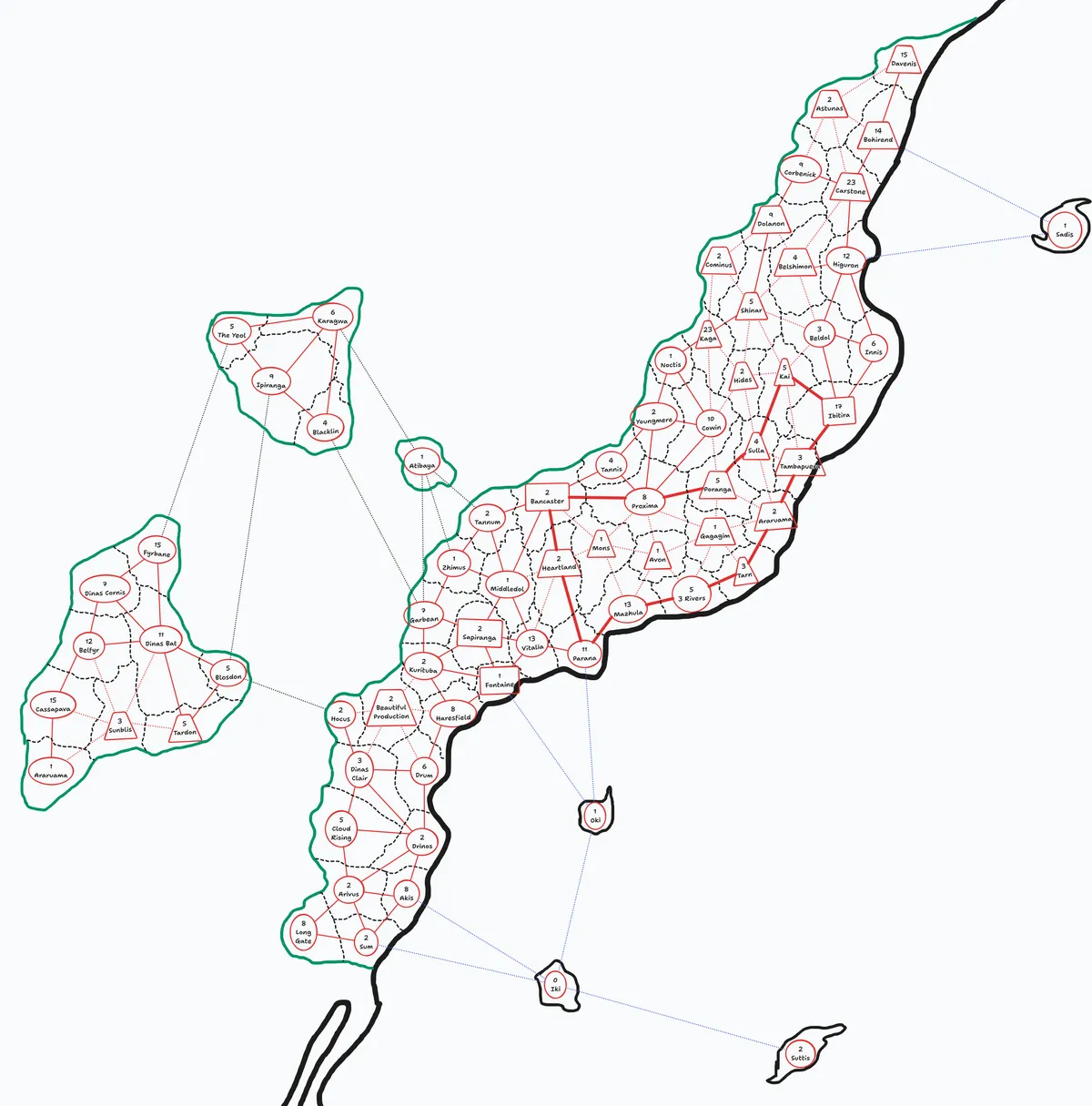
It bears mentioning that all of that below are for the umpire(s) (i.e. for me), NOT targeted at the players. Whenever I run it I will make another post with the player-facing rules. Below is the map I intend to use. These rules were written with the assumptions of the Sunrise Generation setting from my previous campaign.
Game Organisation
Players are divided into teams, each representing the magnate of a certain region and their sphere of influence.1 The players must delegate among themselves, but if there are enough players, it would be ideal to have the positions of:
Leader, who will keep the big picture in mind and help direct the others;
General, responsible for leading troops, keeping track of them, and maintaining a picture of the military situation;
Wife, who keeps track of the internal state of the domain and maintains a picture of unrest, finance, etc;
Each of them may be accompanied by a Retainer - their eldest child, trustworthy bodyguard, close comrade, etc. These are player-characters for people who would rather have lower commitment. Their character is always with the main character and may act as a substitute in the event of the other player being unavailable. Otherwise, they may act as messengers;
The game is divided into 8 halves of seasons, each taking 1 real-life day. So it goes as Early Spring > Late Spring > Early Summer > Late Summer, and so on.
Every half-season the player team will issue orders.
Alliances
Alliances are cemented by one of the following methods, in ascending order of severity:
The word of honour of those concerned, in front of witnesses;
A treaty signed under the auspices of a priest and invoking the holy name of God;[^God]
A treaty as above, but accompanied by an exchange or taking of hostages, usually the heir or wife of the character.
If a PC is taken hostage, they must act as a member of the family of those who took them captive, as that is the custom of the land. In case of a misstep, they will be killed and eaten.
Economics
Income
There are two forms of income: rice and beans (that is, coffee beans, as there is no minted coinage in the world of Sunrise Generation).
Each province produces a certain amount of rice, given in points. Whoever holds the province at Late Autumn will receive that many points in rice. Other provinces produce beans directly.
Provinces taken by force produce only half (rounded down) its nominal income in the first year. This also applies to subsequently recaptured provinces.
Rice and beans are effectively interchangeable in terms of value, their difference lies in storage. For this reason, expenses below will be referred to as "points".
Troops - It costs 1 point to raise an army of 1.000 men.2 Troops must be raised in the provinces that fund them, up to the limits of that province's value. E.g. a 11-point province can only raise 11.000 men.
Troops without a general are treated as garrisons for that province until a general comes and rallies them.
Troops disband during Early Winter, and must be raised again next year.
Defences - Castles3 cost 15 points to build and take 2 points a year to maintain. Fortresses cost 30 points to build and take 5 points a year to maintain. Both take 1 year to build.
Fortresses can only be built as extensions of existing castles, and they cannot be built in the same year.
Castles or fortresses that cannot be maintained are deemed to be abandoned and lose their military value. Recommissioning costs are 8 points for a castle and 20 for a fortress.
Other Expenditures - These are some other expenditures suggested:
Ostentatious public events - Such as a great hunt, a splendid religious festival, things of that sort. They cost at least 2 points minimum. The highest spending grandee in any year will gain prestige.
Ostentatious public building - These must be announced during winter. The grandee that builds and currently holds the most ostentatious building will gain additional prestige. The minimum cost is 5 points and require 1 per building for maintenance.
Flashy uniforms for the troops - Beautiful feathers, body painting done by the most skilled artists, etc. Costs 1 per 2.000 men equipped.
Savings
You cannot save all of the points you acquire from one year to the next. These are the values you actually can save however:
10% of the annual income from rice
50% from additional taxation, such as cities
And 100% from gold mining
All savings must be converted from rice to beans. On top of that, every year you must reduce your savings by 1/3 as the beans go stale.
Prestige and Infamy
The two main sources of prestige are ostentatious spending and titles.
Titles are bequeathed either by the King of Kings or by the Supreme Commander. The King of Kings is a figurehead from which the people believe all power, glory, and prestige emanates from, and he is considered far too pure to govern, thus the Supreme Commander does so in his stead. The King of Kings governs from the central province of Bancaster, and the Supreme Commander from the province of Proximus.
By performing some service or great act in benefit of the King of Kings or the Supreme Commander, the leader of the group can be appointed Governor and / or Constable of a province, respectively.
The King of Kings also grants courtly ranks to leaders. These can be either Low, nominated by the Supreme Commander; Middle, awarded to leaders via recommendation of the Supreme Commander to the King of Kings; and High, which can only be nominated by the King of Kings and virtually never given to non-aristocrats - which is to say, almost never to player characters.
The total is then tallied up, starting at 1 and gaining +1 per:
Holding the most ostentatious public event last year
Holding the most ostentatious public building
Being Governor of a province
Being constable of a province
Having a courtly rank, this counts as +2 for Middle rank and +3 for High rank
Infamy, on the other hand, is accrued whenever the character loots a province, breaks a promise, or is blatantly and publicly cruel in some other form or fashion that is widely considered needless, as judged by the umpire.
Prestige and infamy are both used by the umpire to judge the effects of diplomacy and negotiations.
Warfare
Army Movement & Scouting
Each half-season, generals can move 1 province per point of Experience they have. They may move 1 extra area but the army gains 1 Fatigue marker.
Movement over mountain passes either takes 2 movements or just 1 but the army gets 1 Fatigue marker.
The army can also use 1 movement to rest in friendly territory for the half-season and remove 1 Fatigue marker it has.
At the end of its movement, an army has a chance of having a mutiny in 6 equal to the amount of Fatigue markers it has, and if the chance fails, it will lose 1/5 of its soldiers for each Fatigue box marked to desertion.
If an army becomes mutinous, it will loot the current province, including friendly ones, and then lose 1/3 of its men to desertion. The general may rally the army next half-season.
Extortion: An army may extort 1 Beans from an area as it passes through, provided it could move another time this half-season. The umpire places an "Extorted" marker on that province and it cannot be extorted again until next year.
Looting: An army may spend a half-season looting. This removes all of the Fatigue markers it has, and if it has none, the army starts carrying 1d6 Beans, which will return to its leader once taken back to their home provinces. The umpire places a "Looted" marker on that province and it cannot be looted again for the next 4 years.
Unaligned Provinces: Passage through unaligned lands is assumed provided the army does not extort or loot the area. If these conditions are violated, the ruler of the area raises an army equal to the value of the province to oppose the invader.
There is a chance of Infamy-in-6 that the unaligned province will offer resistance in the shape of an army equal to its value.
Scouting: Armies become aware of other armies in any province adjacent to themselves, as do provinces.
Campaigning and Battles
Generals have an important rating: Experience. It goes from 1 to 4 and it affects how quickly the general can marshal his armies.
The general's Experience times 5 dictates how many thousand men they can lead at one time. If there are two or more generals at the head of the army, the sum of the two highest will be used instead.
Generals increase experience by 1 for every battle won.
Whenever a general enters a space containing an enemy army, the umpire rolls 1d6 + the Experience of both. The winner gets to pick if they seek a battle or avoid it.
Avoiding battle - If avoiding a battle, the general will try to move to another province adjacent to the space they're in. If they don't have any other spaces to move this turn, the army takes 1 Fatigue. Avoidance obeys these restrictions:
The general cannot move into the space their enemy just came from
Armies may not avoid battle into a space controlled by another power, unless it is an ally
Armies may not avoid battle into a space in unrest or with another enemy army
Armies may not avoid battle across sea lanes
Supplies: An army is considered to be supplied if it can draw an unbroken path to its home spaces that is controlled by friendlies and currently free of enemy units. A detachment of 1.000 soldiers occupying an unaligned province counts it for the supply path.
An army without a clear path for more than one half-season is considered undersupplied. I.e. if the army moved away this half-season and joined a battle, it is still considered supplied, but not at the start of the next half-season.
Battles - With the general having chosen to pursue battle, the Attacker and the Defender are chosen. Typically the person who moved into the province is the attacker, even if they weren't the one to have had the final word on there being a battle. Having decided that, the umpire figures out the numerical difference, rounding in favour of the defender. I.e. if 3.000 men assault 4.000, then the odds are 2-3 for the defender; if 4.000 men assault 3.000, then the odds are 1-1 for the purposes of the battle. The acceptable ratios are 1-6, 1-5, 1-4, 1-3, 1-2, 2-3, or 1-1.
Then, each general picks a tactic from:
Outflank
Surprise assault
Fighting withdrawal
Subterfuge
Frontal assault
Fortify in field defences
The umpire then compares the tactics from each according to the table below.
| Defender | ||||||
|---|---|---|---|---|---|---|
| Attacker | Outflank | Surprise Assault | Fighting Withdrawal | Subterfuge | Frontal Assault | Fortify in Field Defences |
| Outflank | 0 | 0 | -1 | -3 | +2 | +1 |
| Surprise Assault | 0 | 0 | -2 | +3 | +1 | -1 |
| Fighting withdrawal | +1 | +2 | 0 | -1 | 0 | -2 |
| Subterfuge | +3 | -3 | 0 | -1 | -1 | 0 |
| Frontal assault | -2 | -1 | 0 | +1 | 0 | +2 |
| Fortify in field defences | -1 | +1 | +2 | 0 | -2 | 0 |
The numbers are how many shifts are made in the odds, from the perspective of the attacker. Other shifts are:
General fighting in his home province shifts 1 in his favour
The general with more experience shifts 1 in his favour
In mountains, the odds are shifted 1 towards 1:1
An army with Fatigue markers shifts 1 against it per marker
Fanatical armies shift 1 in their favour
The army is undersupplied
That is, if the odds are 1-1, the attacking general picks subterfuge and the defender picks outflank, then the odds become 1-3 against the attacker (it shifted from 1-1 to 2-3, 1-2, and 1-3).
Having figured out the ultimate ratio, the umpire rolls 1d6 for each odd. That is, if the odds are 1-1, the umpire rolls 1d6 for each side; if they are 1-4, then they roll 4d6 for one side and 1d6 for the other. The highest number wins.
The winner inflicts half of their dice score in thousands of casualties against the loser. The loser inflicts a quarter of their dice score on the winner. Both round down any fractions.
After the battle, the loser must take 1 Fatigue and retreat to a valid province. If the only valid province is over a pass, they mark another Fatigue.
Reinforcements: On the season following the battle (other than winter), each army recovers manpower as such:
The winner recovers 3/4s of those lost
The loser recovers 1/2
If an army loses its general, it cannot reform until next year.
Death of leaders: The umpire takes a card from a deck for all commanders after a battle. Winners are dead on an ace of spades. Losers are dead on any ace. Any King, Queen, or Jack of Spades indicates they have received a wound and cannot fight, command, or travel for one complete season; except back to friendly territory.
Any leader over 55 who travels during winter or across inhospitable terrain also dies on an Ace of Spades due to illness or accident.
Inhospitable Battles: In the event two hostile armies attempt to cross the same sea lane or savannah trail at the same time, and decide to battle, resolve it in the same way, except:
The Fortify battle tactic cannot be used
All casualties are doubled
Castles and Fortifications: Castles count as an extra 5.000 soldiers in any battle fought in that province; fortresses count as an extra 10.000 soldiers. These are only notional.
Controlling Provinces
When you conquer a province, you have some options:
Force the magnate to submit and become your vassal. If this is the only province of another player, they continue to run it as before, but now as your subordinate. When this happens, the income of the province is unaffected with your taking over, but naturally the risk lies in the loyalty of your new vassal. NPC vassals have a chance of accepting equal to Prestige minus 1 in 6.
Exile the existing ruler and replace them with your own people. This reduces the income of the province as mentioned before, but the province is now under your direct control.
Exact tribute in terms of rice or beans or similar, and withdraw.
Communications
Each player-character has a person of trust, trained to remember specifically-worded messages of up to 140 characters, longer messages require a visit in person.
Messengers typically convey more the meaning than the exact words, and can move a total of 8 provinces per half-season, including the return journey.4 If they pass through hostile territory there is a 1 in 6 chance that they are intercepted on the way.
Smoke Signals: Armies in neighbouring provinces can send a single-word message back to any character in any province adjacent to it, provided there are friendlies there willing to relay the smoke signal.
In Sunrise Generation, this typically means a personally influential warrior and their partisans, members of his faction, which typically also form their extended family. Terms such as "grandees" and "leaders" all denote the same thing. Some peoples do practice kingship, however, and have hereditary rulers who govern absolutely.↩
These are always skirmisher infantry, there are no horses or mountable animals in Sunrise Generation. It is said that there are some in the mountains to the far west, but they're no good for warfare.↩
Typically earthworks, with fortifications providing even more extensive earthworks.↩
This assumes they are running. There are no beasts of burden in Sunrise Generation.↩