How Arden Vul uses its size
Everyone knows that it's not the size of the dungeon that matters, it's how you use it, so after a month of running Arden Vul I've decided to reflect about what it is doing, how it does that, and why I have been enjoying it.
For context, the Weasels have thus far explored 34 rooms spread over 3 levels, found some treasure, and had only one fight with a pair of skeletal baboons. This means they've explored about 2% of the dungeon, which has around 1500 rooms - and implies that it would take around 4 and a half years to fully finish playing it if they keep up this pace, though that is faulty thinking, not every room is there to be explored.
Look upon my works, ye mighty
Arden Vul has a lot of empty rooms, but they're not all empty. I have seen criticism of this and of the way it is written, which is fair enough, as Bryce from Ten Foot Pole says:
The room of Jhentis the Ghoul is a good example of this. In the middle of a floor covered in shards of broken bottles, a strange throne of bone and wood scrap rests on a desk that rests in turn on a table Jhentis sits on this throne gnawing bones and murmuring hungrily and angrily, wearing a key around his neck and piled next his throne are coins, jewelry, unbroken bottles and scrolls. But that’s not the description we get. Instead this is the description we get:
And then posts the description, which starts by what the room once was and what it now is. To him this is a bad thing, but I really like it. It's maximalistic and instantly gives you a clue on what this once was, thus allowing you to make calls based on that.
I think this is relevant because Arden Vul has many empty locations, but all of it "makes sense" in a very non-Mythic Underworld way. Parts of it are temple compounds and parts are caverns, and there is obviously some leeway because it is a work of fantasy after all (yesterday we found a bedroom that was 40 x 20 feet, easily bigger than a lot of modern apartments lol), but I haven't seen anything yet that is there exclusively for game reasons.
Hidden passageways are explained as what the priests used to spy on their initiates, doors aren't all stuck, the "monsters" are either animals or regular people who aren't very magically affected by the dungeon, etc. I don't think the explanations have to be particularly good, but just the fact that they're there makes a world of difference.
Interconnectivity without going bonkers
Nathan once said the OSR is addicted to Jaquaysing and pointed out how some small dungeons are so "Jaquaysed that there are no meaningful choices". This is something I like about Arden Vul, you always have a few choices of where to go, but they're usually contained within one of a few quadrants, which the denizens of the dungeon are actually aware of and are using as "natural borders" for their territory. Plus quite a few rooms are lit, so you can often see the light down the corridor and that's an immediate interesting choice.
This is to say that Arden Vul is quite big and connected, yes, but it is explorable. It's not all corridors with infinite choices, there have been very few intersections with more than 3 exits until now, and none with more than 4 I think, and while I know they exist (because I've seen the map), they're rare. Siloing the dungeon does make it feel a bit like a few different dungeons stacked under a trench-coat, but that's where the connectivity comes in: there are a lot of ways that you can go down a level or up a level, there's a chasm cutting through the middle of the dungeon, there are holes, etc. It's obviously a bad idea to go down them initially, but their presence is very interesting.
It's telling a little story
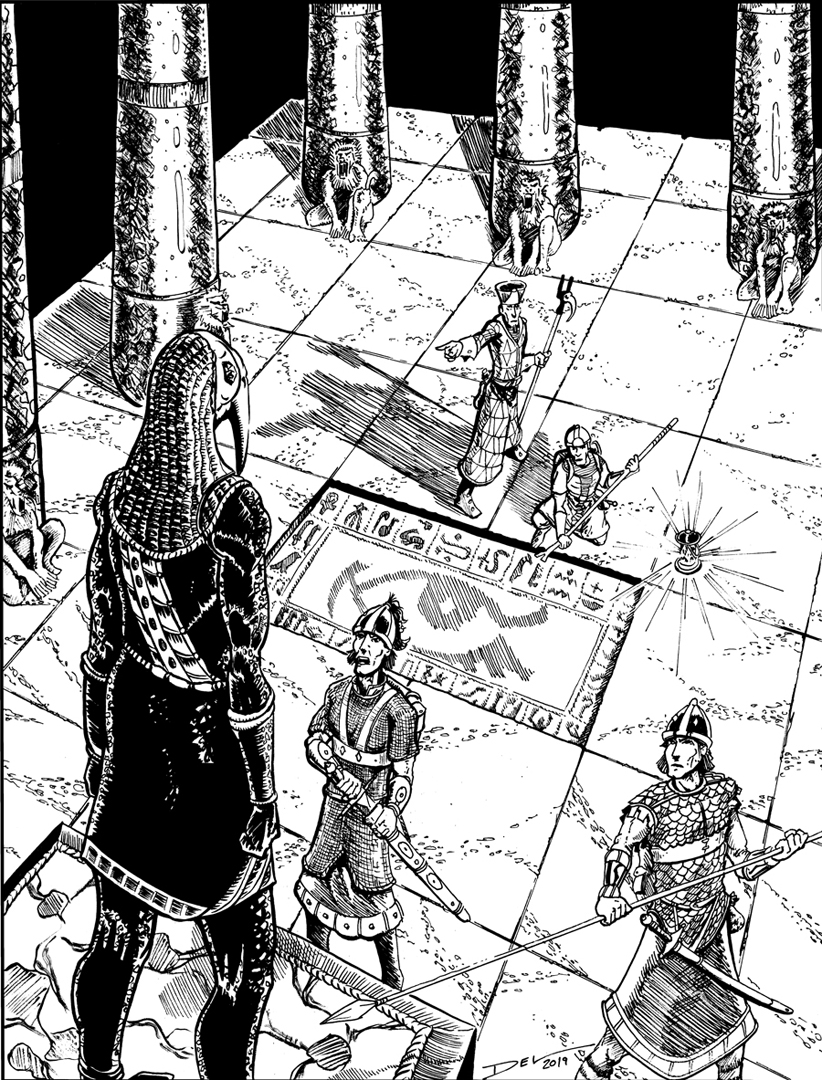
Arden Vul tells a little story with its layout. Not a very complex story, and one any player already knows: there was once a mighty city, and then it fell. That's about it. It goes on to elaborate on individuals that might have been there, specific rooms have plaster and depictions that have survived the centuries, but the basis of it is that city and what it was built upon.
I think the lack of complexity works in its favour, because it allows for repetition. Sure, Arden Vul existed for over 500 years, why would we be always talking about Marius Tricotor the 1st Archon, or Adriennic the guy who came in later? Because they're who matters. Through this you could potentially feel like you know a little bit of the history of Arden Vul. The DM knows there is no such history - the book doesn't give much beyond a timeline and generalities spread over the rooms - but it doesn't have to.
I do wish it was a bit more human with it. There's a certain architect's coldness to Arden Vul and the way it deals with the people within, and this is best expressed by how the dead bodies are described. They're a common source of treasure, but often there's not even apparent gender assigned to them, turning them into an object, a vessel of treasure. But not all dungeons can be The Flooded Tomb of the Aurochs Vikramarka.
Encounters are few and far between
I can count in one hand how many random encounters we've had in 4 sessions. They happen on a 1 in 6 every 3 turns for most levels, which makes the entire dungeon feel howlingly empty. You can see the traits of habitation here and there, you know there are monsters here somewhere, yet you cannot see them.
From the DM chair, Arden Vul looks positively crowded. There are a ton of rooms with one million monsters, but they are almost all out of the way, and you get plenty of warning before reaching them, almost like travelling a distant land and seeing little villages pop up before reaching a mighty city.
The Books
I think the books are so cool. My players have only found one, but there are a ton of them. Some are "important lore", but a few are just trashy romances from long ago and things like that. They're actual books! They add so much to the setting and the dungeon. A cheap, trashy romance in the desk of the bedroom of a once-powerful archon is just so much characterisation, you barely need anything more than that.
And more!
That's all my thoughts as of today, but I'm sure there will be more. I am intrigued by how, if you pay attention to the dungeon, it gives you clues towards how to interact with some of its inhabitants. There is a certain weight to some factions and monsters, because they've interacted with humans before and they know a lot more of the PCs history than they themselves know. But there's also a lot of interactivity, there's Zelda-ass puzzles around, One Hundred Million Apes, references to Elric, etc. It's a cool dungeon!
It really inspires me to make my own. I could expand on Arden Vul, but the challenge is so tantalising. Maybe I will. The biggest issue to me is making something without playing it, but if I can get over that hurdle, I think I can have some fun with it.
My ultimate goal, which might not even be possible, is to merge what I'm learning with Hearts Aglow and what I'm learning with Arden Vul eventually. There is the possibility there of a dungeon that isn't even about getting stronger and more powerful, but rather about recovering lost knowledge, figuring out history from once upon a time, and also focused almost entirely on people, but I can't quite crack it at this point.
They're basically on opposite ends of the aisle, too. In Hearts Aglow, locations are holders for people, whereas in Arden Vul, people are almost physical manifestations of the location. There has to be a middle path. I'll think about this.